

Green Book Reports
War on Gaza
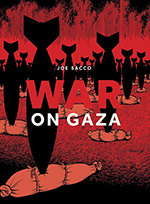
by Joe Sacco, (2024) Fantagraphics Books, 30 pages. Available at the Corvallis Benton County Library, call number GRAPHIC 956.94055 SACCO
Portland comic book artist Joe Sacco is the author of two previous longer format graphic novels about Palestine, Palestine (1993) and Footnotes on Gaza (2010). All are available at our public library. This recent short compilation of polemical images and stories was prepared as a response to the current genocide being committed by Israel with the full backing of the United States. Sacco addresses the futility of nonviolent resistance, which was met with lethal violence by the Israeli Defense Forces. He explores the duplicity, lies and apparent senior dementia of the Biden administration as it sought to justify the unjustifiable. Sacco creates a modernized version of the destruction of Sodom and Gomorrah in which Joe Biden is turned into a pillar of votes for Jill Stein when like Lot’s wife he ignores the warning to not look back at the carnage. The most moving part of this collection is an illustration of his guilt, as an American citizen, who pays taxes to support the murder of Palestinian children. Although he writes and draws with humor, Sacco effectively evokes the outrage needed at this time in history.
Tribal Histories of the Willamette Valley
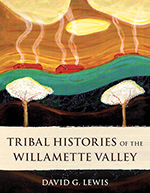
by David G. Lewis 2023, Ooligan Press, 238 pages. At the Corvallis Benton County Library, call # 970.00497 LEWIS.
The author is a professor of anthropology and Indigenous studies at Oregon State University, and a member of the Confederated Tribes of the Grand Ronde. He writes a blog, the Quartux Journal
I highly recommend this book for anyone living in Willamette Valley. It recounts the experience of the Kalapuya, the indigenous people of the Willamette valley, from the start of the 19th century to today. It gives insights to the lived experiences of indigenous people as their homeland was taken over by settlers. Here is a simplified summary of that history:
Kalapuya lived in the Willamette Valley for over 10,000 years. Starting in the 1770s, epidemics of European introduced diseases, primarily malaria, reduced the population of the Kalapuya by more than 90%. Large numbers of white settlers began arriving in the 1840s encouraged by grants of 640 acre allotments. Kalapuya were impressed by the possession of metal tools, cattle and horses and new agricultural and housing technology of the settlers. However, conflicts started as the number of settlers increased and they demanded the displacement of Kalapuya from the most desirable lands. Oregon City, Salem, Lebanon and Eugene were major population centers of Kalapuya people before the white invasion. Settler agricultural practices destroyed resources essential to the livelihood of the Kalapuya such as camas and wapato. In 1851 a series of 19 treaties were negotiated to ensure the rights of tribes on dedicated reservations, separated from settler communities. The treaties included promises of home construction, schools, healthcare, clothing, agricultural implements and cash. Many Kalapuya relocated based on these promises. Settlers immediately occupied the abandoned lands. However, the US Congress refused to ratify the treaties. Kalapuya lost their homelands without compensation. A treaty negotiated in 1855, and subsequently ratified, established the Grand Ronde reservation. Federal Indian agents attempted to move all Willamette Valley Kalapuya to Grand Ronde with the same inducements, now with the guarantee of a ratified treaty. However, the promises were never kept because Congress would not allocate adequate funding. Kalapuya on the Grand Ronde remained impoverished. Starting in 1887, allotments of 260 acres of reservation lands were granted to some individual Kalapuya on the Grand Ronde reservation. Many allotment applications were never processed. The government then sold unallotted lands to white farmers. In the 1950s tribal recognitions were terminated, ending all obligation of the federal government to indigenous people, and making indigenous people citizens of the United States. Oregon laws prohibiting sale of alcohol and marriage to white people were overturned in 1952. Restoration of tribal recognitions began in 1977 and are still in progress for some tribes. The most recent in Oregon was the 1989 restoration of the Coquille tribe.
The book ends with some ideas about restorative justice. Indigenous people joke about lands acknowledgements, “Yeah, we have your stuff, yes, it is your stuff, but you can’t have it back.” The Lands Back movement has seen some voluntary private donations of land to tribal ownership. Major state and federally owned lands could be returned to tribes, but they would require accompanying funding for management. Certainly, any resources extracted from lands illegally taken from tribes should be accompanied by compensation to tribes. Oregon State University, which was built on unceded tribal land could offer free tuition to tribal students as compensation for the stolen land.